Achieve Your Fantasy Fitness
Achieving Fantasy Fitness
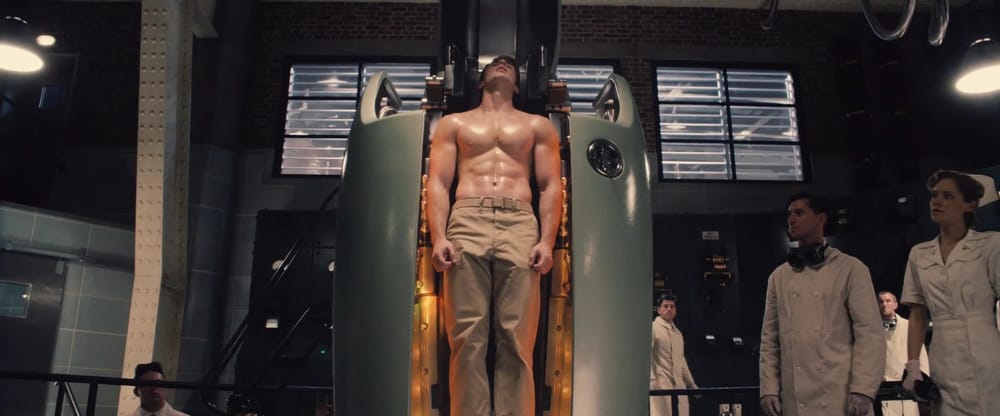
How to Look and Perform Like Captain America, Without the Super Soldier Serum (Or Other Drugs)
Wednesday, May 22, 2024
Get all the details below:
How to Look and Perform Like Captain America, Without the Super Soldier Serum (or other drugs)
Oh, to be in the MCU where you can be transformed into a superhuman by being bitten by a spider, exposed to gamma radiation, or with just a few needles and an incubation chamber!
(Which would you choose??)
But alas, in our universe we have to actually work to make the type of changes Steve Rogers made 😩
He may still have a few characteristics that we can’t train for, like slower aging, processing alcohol faster, extreme durability, and being able to pick up Mjolnir, but at least there’s a lot that we can train for!
So here is exactly how we can train to look and perform like Captain America without the exogenous support!
The Goals:
Captain America is most well-known for a few things…
1) Some of the juiciest pecs ever seen on the big screen
2) Being able to, “… do this all day.”
3) Being the owner of America’s @$$
Putting it into simpler terms, he’s got a great physique and a humongous gas tank.
He’s also very strong, fast, athletic, etc. So essentially the goal is to max out all aspects of fitness 😅
- Muscle Size (Hypertrophy)
- Strength
- Conditioning
- Athleticism/Power/Movement Capability
The issue here is that you can’t take every aspect of fitness to its absolute max (even with exogenous support) (AKA Steroids).
There comes a point where pursuing strength will decrease your ability to pursue size. Likewise chasing size will, eventually, limit the amount you can chase conditioning. Etcetera etcetera.
If we treated this like a video game character and we were allotting points to various attributes, you’re never given enough points to max out every attribute, right? That would make you way too OP and the game wouldn’t be as fun.
Well, that’s honestly kind of similar to how real life works!
So for Captain America, who is probably the most well-rounded superhero in the MCU, we need to structure our training program to increase all the aspects of fitness, without letting them negatively impact each other.
The Training
Ideally, we wouldn’t be training for multiple goals at once. Workouts and recovery both become more challenging the more adaptations we train for.
For example, athletes go through phases of training that go from…
- Offseason Hypertrophy
- Pre-Season Strength → Power Development
- During Season Maintenance
This is very general; the length of these phases depends on both the sport and the athlete but the reason for the phases is because you can get more out of training when you’re focused on one outcome. (Analogous to most things in life)
For the most part it’s pretty simple to train for each aspect of fitness.
- Muscle mass = take each muscle group close to failure 8–16 times per week.
- Strength = make a muscle group work really hard to lift something up.
- Conditioning = get your heart rate to a certain range and keep it there as long as you can.
- Speed/power and athleticism might be a little more complicated. There’s elasticity, rate of force development, movement capability, coordination, etc. But you can still train for it just like everything else.
Like I said, it’s not ideal to train for everything all at once BUT! It’s more fun, so we’re gonna do it anyways 😁
Here’s what it will look like…
Considering we are limited to what our bodies can recover from (naturally), we are going to break the program up into 4 training days, 2 conditioning days, and 1 recovery day.
The training days will be split up further into 3 strength/hypertrophy/movement days and then one HIIT day.
The 2 conditioning days will be low conditioning and the recovery day will just be a day to do whatever you’d like. Ideally some movement would be involved like a long walk, a yoga class, anything that is easy on the body but keeps us moving.
Training Days
There are a lot of ways you can structure these and there’s a lot of debate on what the best type of training splits are. Here’s how you find out what the best training split is for you…
- Are you lifting 4 or fewer times per week?
If yes, full body training is probably best.
- Are you lifting 4–5 days per week?
If yes, Lower → Upper → Lower → Upper → Accessory will probably work great.
- Are you lifting 6–7 days per week?
If yes, do whatever muscle group splits you want provided that you hit each one twice per week.
FYI, I do not recommend lifting more than 5 days per week if you are natural.
We are lifting 4 or fewer times per week so we’ll stick with full body days! Three days will be strength, hypertrophy, and movement focused. One day will be a HIIT day aka a high conditioning day that will help with power and athleticism.
Days 1–3
These are all structured the same, just with different exercises.
- Reset
- Warm-up
- Ramp-up
- Main Strength
- Secondary Strength
- Hypertrophy Accessories

By the way, this is exactly how I train, and I post all of my programs for free! >>If you want to train to look and perform like a super hero, go here!<<
This example has 6 exercises. I have found the sweet spot to be 5–6. It depends on the fitness level of the individual/ how much time you have and what you can recover from.
The flow would go like this…
- Do the “Resets” which are just exercises to help get your body into a good position/ moving and feeling good.
- Followed by the “Warm-up” which is quite literally to warm up your body. Those are just movements I like and can definitely be changed.
- Then the “Ramp-up”. These are power movements that will get the nervous system fired up as well as work on some power output. There’s a lot of wiggle room here and the exercises would likely change over the course of a program.
- Now you’re ready for the Main Strength exercise. These are often a variation of the big 3 (Squat, Bench, and Deadlift). In the example provided you would do all sets for this exercise with the appropriate amount of rest between each set (2–5 min). Reps are typically on the lower side (1–8) depending on the phase you’re in as well as your training age.
- The “Secondary Strength” exercises are a super set, so you go back-to-back with 1–2 mins of rest between each set. These are still larger/compound movements but a bit more focused on range of motion, tempo, and higher reps (5–12).
- Lastly the “Accessory Hypertrophy” is a tri set. Same idea as the “Secondary Strength” but with less rest. These exercises are more isolation focused where you really try to smoke one muscle. Like Bicep Curls, Triceps Extensions, Hamstring Curls, Shoulder Raises, or direct Ab work. The reps here can be anywhere from 6–20.
Day 4 HIIT
HIIT (High Intensity Interval Training) is another form of conditioning with the added bonus of getting some power development.
When you’re doing HIIT you don’t want to go hard and heavy, like you do for strength and hypertrophy training, you want to go hard and light. This allows you to not only move the weight at high speeds but also to do many more reps!
The exercises you choose can vary greatly it mostly depends on…
- Can you keep good form for high reps.
- Will it get your heart rate high.
- Can you perform it quickly.
- Will your heart fatigue before your muscles.
Anything from bike sprints to light weight circuit training will work here. At the beginning of the workout do a few sets that a more power focused like…
- Jumps
- Cleans
- Squat Presses
Reps until power starts to decrease. Light to medium weight with high intensity/speed.
Then as the workout progresses move into easier to perform exercises where you can really push the intensity…
- KB swings
- Push-ups/ Plyo Push-ups
- Lunge Jumps
- Explosive Pull-ups (NOT KIPPING PULL-UPS)
Reps until muscles fatigue but VERY little rest between exercises. We want the heart rate to be the limiting factor NOT your muscles. Light weight with high intensity.
Conditioning Days
The Conditioning Days are the exact opposite of the HIIT Day. Instead of highly intense bursts of exercise, we want long, slow, and steady bouts of exercise.
What is popularly known as “Zone 2” conditioning.
This is the type of exercise that gives you the, “I could do this all day.” Gas tank. Although I don’t think it will improve your ability to take a beating…
Anyways, you can do literally anything that will keep your heart rate in the “Zone 2” range. This will vary a bit from person to person, but a good heart rate range is 130–150 BPM. Or you can measure by your ability to breathe through your nose.
Ideally you would be able to breathe through your nose (or at the very least breathe in through your nose and out through your mouth) the entire time BUT it should be tough.
- Incline walking
- Rowing machine
- Air bike
- Jogging
- Cycling
Anything that you can/will do for 30–90 minutes.
Recovery
I already mentioned how the recovery day should be a day with easy movement. We don’t want to remain stagnant because blood flow will aide in recovery, plus movement during the day will help us sleep at night.
- Long walk
- Kayak
- Hike
- Yoga
Again, it’s more of, what will you actually do? If you hate yoga, don’t make yourself go to a yoga class!
And that’s it!
Of course there is the nutrition side of things but that is a topic for another time! Until then, feel free to reach out with any questions.
And if you want to train like this…
I make all of my programs available for free!
If you’re ready to look, feel, and perform like a superhero, get started now!
Until next time,
Best,
Ryan Sandmann
Find This Helpful??
Consider following me on Instagram!
It's where I'm most active and you are most likely to get a hold of me with any questions.